Deep Dive: E9B06
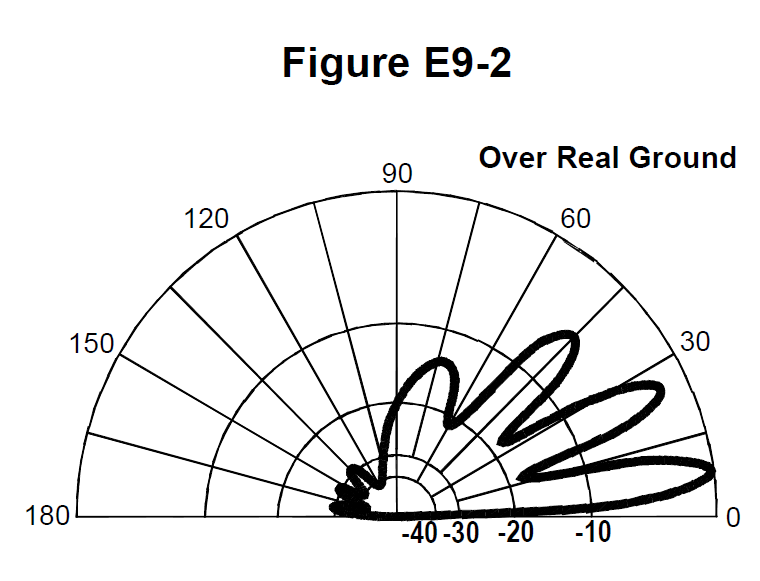
The correct answer is C: 7.5 degrees. The elevation angle of peak response in the antenna radiation pattern shown in Figure E9-2 is 7.5 degrees. This is the take-off angle where the antenna radiates most strongly. The elevation pattern shows how the antenna radiates at different vertical angles. The peak response occurs at 7.5 degrees elevation, which is a low take-off angle. Low take-off angles (like 7.5 degrees) are excellent for long-distance communications because the signal travels at a shallow angle, maximizing skip distance. This is ideal for DX (long-distance) work. Higher elevation angles would be better for shorter distances but less effective for DX.
Why Other Answers Are Wrong
Option A: Incorrect. 45 degrees would be a high take-off angle, not the peak shown in the pattern. Option B: Incorrect. 75 degrees would be a very high take-off angle, almost straight up, which is not the peak. Option D: Incorrect. 25 degrees is higher than the actual peak elevation angle of 7.5 degrees shown in the pattern.
Exam Tip
Peak elevation angle = Read from pattern. Remember: The elevation angle of peak response is where the antenna radiates strongest. For Figure E9-2, it's 7.5 degrees - a low take-off angle good for DX.
Memory Aid
**P**eak **E**levation **E**9-**2** = **7**.**5** degrees (think 'PEE9-2 = 7.5°')
Real-World Example
You're analyzing the elevation pattern in Figure E9-2. The pattern shows peak radiation at 7.5 degrees elevation. This low take-off angle means your antenna radiates strongest at a shallow angle, which is perfect for long-distance communications. Signals at 7.5 degrees can travel far via ionospheric skip.
Source & Coverage
Question Pool: 2024-2028 Question Pool
Subelement: E9B
Reference: FCC Part 97.3
Key Concepts
Official Pool Source
Question text and answer key are synchronized with the current NCVEC Extra Class pool and mapped to the E9B topic.