Deep Dive: E7D06
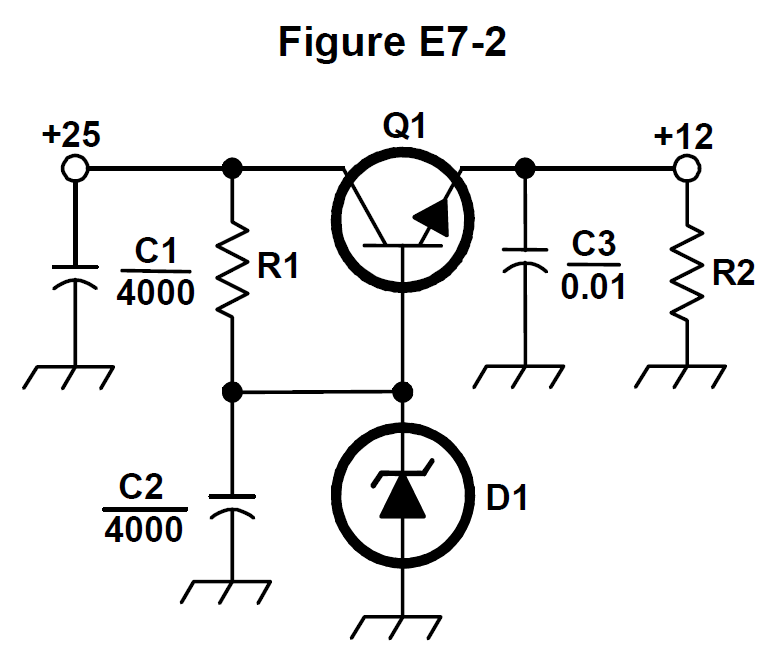
The correct answer is C: It controls the current to keep the output voltage constant. What is the purpose of Q1 in the circuit shown in Figure E7-2 is that it controls the current to keep the output voltage constant. Q1 is the pass transistor that controls current. For amateur radio operators, this is important for power supply design. Understanding this helps when analyzing regulator circuits.
Why Other Answers Are Wrong
Option A: Incorrect. Providing negative feedback isn't the purpose - Q1 controls current to keep output constant. Negative feedback isn't the purpose. Option B: Incorrect. Providing constant load isn't the purpose - Q1 controls current to keep output constant. Constant load isn't the purpose. Option D: Incorrect. Providing regulation by switching/chopping isn't the purpose - Q1 controls current linearly. Switching/chopping isn't the purpose.
Exam Tip
Q1 in Figure E7-2 purpose = controls current to keep output voltage constant. Think 'Q'1 = 'C'ontrols 'C'urrent (pass transistor). Q1 is the pass transistor that controls current. Not negative feedback, not constant load, not switching - just controls current.
Memory Aid
Q1 in Figure E7-2 purpose = controls current to keep output voltage constant. Think 'Q'1 = 'C'ontrols 'C'urrent. Q1 is the pass transistor that controls current. Important for power supply design.
Real-World Example
Q1 in the circuit shown in Figure E7-2: Its purpose is to control the current to keep the output voltage constant. Q1 acts as the pass transistor in a linear regulator. This is the purpose - controls current to keep output constant.
Source & Coverage
Question Pool: 2024-2028 Question Pool
Subelement: E7D
Reference: 2024-2028 Question Pool · E7 - Practical Circuits
Key Concepts
Official Pool Source
Question text and answer key are synchronized with the current NCVEC Extra Class pool and mapped to the E7D topic.